  |
| Authors one in the same? |
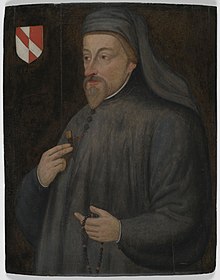
Chaucer's Canterbury Tales is a collection of stories that achieved many firsts in the English-speaking world, in spite of French and Latin, the lingua francas in England at the time. He was essentially the Shakespeare of the Middle Ages (even sporting some of the same bathroom humor, but in much more excess). Centuries before the Bard would pen his famous poetry and plays of countless firsts, the early Chaucer showed the world to unique characters with laughter, tragedy, and vulgarity in peculiar fashion. His 17,000 line tale (or rather, tale of tales) would serve as an influence for generations of writers, even Shakespeare himself.
Most notably is Chaucer's writing style. The Canterbury Tales incorporates both rhymes and prose to contrast certain ideas. As for the poetic parts, he uses a meter consistently where each line is decasyllable, having ten syllables, and often using a caesura (in our text, denoted by commas), dividing most lines in two. Chaucer would use two rhyming styles: riding rhyme and rhyme royal, of which he pioneered the latter. Riding rhyme is the style Chaucer more frequently used and is exemplified best by the two tales we read in class. The only way I can describe its rhythm is that it tries to emulate "riding" like on a horse, but without the gallops over a stanza (I don't really know how else to put it in words). Riding rhyme would serve to be one of the first examples of heroic verse in Middle English similar how Epic of Gilgamesh in Mesopotamia set the standard for early Cuneiform writings (or even embodies the literary triumphs of the Middle English and Sanskrit respectively). On the other hand, rhyme royal is more interesting; it's scheme is ababbcc. Rhyme royal syncs well with Chaucer's meter, which is considered to be a progenitor to iambic pentameter--made famous by Shakespearean sonnets.
As for Chaucer himself, he demonstrates himself to be the most skilled of writers. He outlined and detailed the backgrounds, quirks, and personalities of twenty-four unique travelers--or better simply put as individuals. In his time, the association between pilgrims and storytelling was well-known. However, among all of his other firsts, Chaucer was the first to write such a diverse cast of pilgrims. Retreats were thought to always be homogeneous pilgrim convoys, with similar backgrounds and the same goal. But, Chaucer is able to intertwine many one-of-a-kind persons not on the basis of race, but rather on occupation, social standing, and, their good-evil bends, as we discussed in class.
Through his remarkable abilities to illustrate diverse characters and revolutionize English poetic devices, Chaucer becomes one of the most ambitious English writers of all-time, let alone his dominance of Middle English literature. Some of his other feats include: providing a standard for the usage of the story within a story literary device (similar to Frankenstein, actually), and of course, penning what is considered to be the first English modern novel.

