Showing posts with label Learning. Show all posts

Monday, January 23, 2017

Benefits of High School Abroad by Carly Piniaha

    Doing things alone can be scary, whether it be something little like going into a store alone or as big as traveling alone. Though each experience we go through like these make us more independent and self-sufficient. High schoolers are at a point in their life where they are starting to learn what it is to have both these attributes. Studying abroad is a great opportunity for students to develop these skills. You have to rely on yourself rather than your usual home support system. Studies have shown that living abroad in high school increases both confidence and maturity. All parents want the best for their kids. To go out into the world and be able to thrive. By having the lessons you learned through your time abroad you can do just that.
   The inclusion of studying abroad on your college applications can also help in the time of college admissions. Admission boards love the words "leadership" and "global" and studying abroad can fit into both categories. Types of abroad programs can even be service projects that are student lead, which also shows community service. Studying abroad shows you possess knowledge of other cultures and can effectively analyze and solve culturally sensitive problems. Moreover, knowing a foreign language can make your application stand out among others. It shows you take academics seriously. And the only way one can become truly fluent is to be immersed in the language. How does one become immersed you ask? studying abroad!
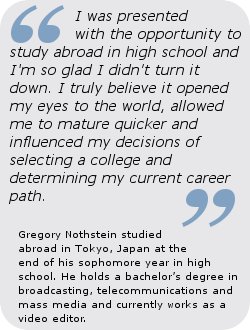
   Not only can you boost your admission chances, you can receive college credits for courses taken overseas! Taking the initiative to get college credits while still in high school further show your respect for academics. Sure, AP classes are great to take to get college credit. Me personally? Well, I would rather get college credits while strolling through the streets of Spain or France than sitting through an AP exam I'm not even sure a college will accept. So what are you waiting for? The whole world is out there for the taking if you would just open yourself up to new experiences. Make new friends you would have never made without leaving the country! Try new things! Studying abroad will open doors in your life you never even knew existed.


Tuesday, November 1, 2016

We are What We Read By Ashley Lasko
While this phrase is heavily inspired by the phrase, “you are what you it eat”, I say it in the opposite context. Rather that the books shaping our image, our books are shaped by who we are as a society.
We have recently finished finished our second unit in English, and one focal point during the unit was how heroes in a culture’s story reflected the values of the culture. We focused on Beowulf, who was described to be strong, brave, honorable, and wise. These traits, naturally, reflected the values of the Geats; Beowulf being a Geat himself. We were tasked with an essay, in which we analyzed how a myth of our choice embodied its country of origin’s values.
As I began analyzing the values of my myth to the values of its country, I began to grow curious. I hypothesized that, just as myths had reflected the cultures of centuries ago, modern books, TV, shows, and movies likely represented our society today.
Popular stories these past years, such as The Hunger Games, Lord of The Rings, and Harry Potter reflect our society's emphasis on individuality and overachievement. Stories such as Pitch Perfect represent our society's views of the importance of having a good laugh, being unique, and never abandoning dreams. Novels and fantasies such as The Fault in Our Stars place significance on loyalty, mental endurance, and pure love.
This blog may not open your mind to a completely new concept, or teach you something you’ll apply everyday. However, it is intriguing to think of how the stories we wish to tell as a society reveal our values. Simply, it’s compelling to think, next time you pick up a book or sit down to watch a movie or TV show, that the story you are experiencing is the values of world today translated for enjoyment.

Friday, September 30, 2016

Middle and Elementary English: What We've Learned By Ashley Lasko

Before discussing what skills we have taken away from our middle school and grade school years, I’d like to clarify a few things. To begin, I have met some amazing teachers before my first year as a high school student. I am avoiding listing specific teachers, as I would inevitably neglect to mention a few. However, I can confidently say many teachers in middle and elementary schools have been tasked with preparing me for later years, and all have excelled. Also, I will only be analyzing the “irony” of middle school and grade school from an English perspective, considering the blog is dedicated to the study of English.


In regards to this post’s focus, I have discovered I went into High School misinformed. I believed the first sentence in any essay consisted of a question, fact, quote, or definition; that three body paragraphs were guaranteed to earn a passing grade; theses had to have an idea and three supporting details; and a standard paragraph must have 5 to 8 sentences. Of course, the possibility that a Freshman walked into school on the first day knowing a high school-worthy design for an essay is likely. Nonetheless, my experience with my peers and teachers suggest many students have developed strict habits that limit and deteriorate their writing.
The patterns listed earlier can plague a student’s writing, but can aid a second or third grader still learning how to properly express ideas through pencil and paper. Early in an educational career, students develop skills to answer open-ended questions and argue points. Limiting grade school students introductions, paragraphs, sentences, and theses ensures students will put proper effort into their work and that the student’s work will be correct. Unfortunately, students are guided through this “elementary” structure of an essay but not informed of a more formal and free style in middle school. I will acknowledge that in middle school English teachers also cover a variety of skills; such as reading, inferences, quotes, and counter-arguments. Both grade and middle school teachers have a vast curriculum to teach their students within a limited time. Sophisticated essay skills are never taught simply because of the way education is organized.
The early introduction of simple essay skills, and the lack of introduction to improved abilities later on, can undermine a student’s writing. However, English teachers in high school have been willing to clarify and introduce to these skills to their students. I did not write this blog with the intent of belittling teachers who are currently working in elementary or grade school, or to blame a specific group for the lack of skills my peers and I entered high school with. I constructed this blog with the intent of directing attention to a problem. While a proper, perfect solution to this problem may not exist, I believe aid from teachers as well as extra work from students led to the fantastic writers and readers I learn besides today.


Thank you for reading my blog, and thanks for all the teachers I’ve had throughout the years. I know this statement is overused, but I truly would not be as skilled as I am today without all of your effort.

Image result for nothing is impossible quotes

Monday, September 26, 2016

Are We Products of a Learning (R)evolution? (By Chris Hwang)

In the eyes of most students, every new school year is accompanied by a set of expectations, hopes, fears, and anxieties. This was no different for me and I have come to expect a fair amount of surprises. After all, I have already been a student for more than two thirds of my life. Without giving it much thought until recently, I now realize that each new school year has been accompanied by new methods of learning (and teaching). In sixth grade, my former middle school in CT adopted the common core. Imagine mass chaos and confusion among the students and teachers as the traditional was ditched for the new. Then just before 9th grade, my family relocated to NJ, which has given me even more perspective. And now, I start my 2nd year of high school. So for me, it has been one big transition after the next. I thought to myself, “can I stomach another big transition at school this year?” After reflecting on my first three weeks of attending Mrs. Kopp’s English 10H class, I can sense that this will be an exciting year for me and hopefully for my classmates. For starters, this English class doesn’t appear to be your typical lecture-style class where we sit back as passive learners trying to ingest all that the teacher has dictated. Nor have we been forced to read a ton of “mandatory” textbook material. Mrs. Kopp is encouraging us to become active learners where we have freedom to select what we want to read while developing our “own” voice to write about whatever is on our minds whether the topic is humorous, trivial, or even controversial. I have written personal journals in the past so freestyle writing isn’t exactly new to me. However, this is my first time blogging and blogging implies that I will have an audience. Thus, before starting this blog, I contemplated taking the “safe” road and writing about something mundane and neutral. However, I kept getting drawn to the fact that I have been given carte blanche to use my own creativity to say what I want to say in my own voice.

So I’ve decided to take a risk and relay my personal thoughts about a topic that is controversial and sometimes polarizing. That is, the topic of testing. The perpetual cycle of eat, sleep, test, repeat doesn’t seem to ever end. On any given week, it is a mathematical certainty that we will be forced to endure an abundance of tests. We will need to endure formative after formative and summative after summative exams. When did the tide turn? Did all the testing accompany common core or was it here all along? Is all the testing really necessary to prove that we are learning or that the teachers are teaching? And it’s not just the testing that makes many of us anxious and stressed. It’s also the amount of prep. work (studying) for the tests that induces anxiety, fear, and fatigue. I would rather be motivated by the desire to learn vs. the fear of performing poorly on a test. As a varsity athlete, I know the importance of balancing academics with athletics. But are we really balancing the “learning” or is it more about the “testing?” Last winter, I recall a two-week period in which I was tested 13 times. Yes, thirteen exams in a short two-week period. Mathematically, that equates to 9 hours of testing. While studying for those tests, I couldn’t help but wonder whether those 9 hours of testing could’ve been 9 hours of learning (teacher instruction) instead. After all, testing time is precious learning time. On top of that testing, I spent at least 15 or more hours preparing for those tests. This brings me to my next point. There are other ways to measure student understanding and growth. Perhaps that can be another topic for my next blog.

So are we products of a learning evolution or learning revolution? Evolution implies continuous enhancement and revolution implies sudden change (usually brought about by a catastrophe). The jury is still out. For now, I will enjoy the privilege granted to me by Mrs. Kopp and our new flex schedule to select my own books for independent reading and to blog about any topic that is near and dear to me. To put things in perspective, I write all the time because I need to. This time, I wrote (blogged) because I enjoyed it.