|
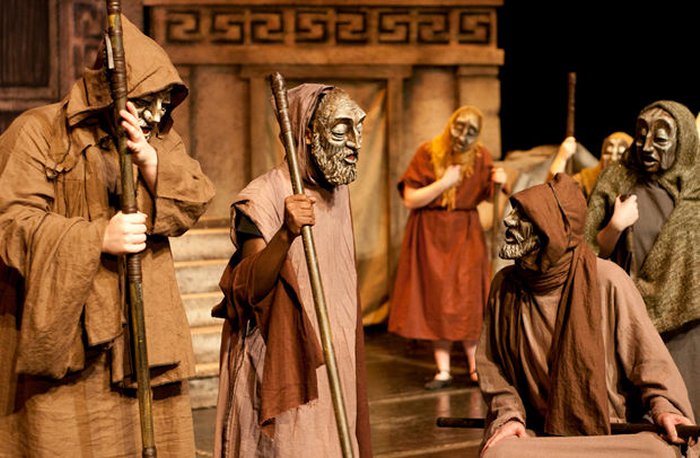
| A standard Greek chorus |
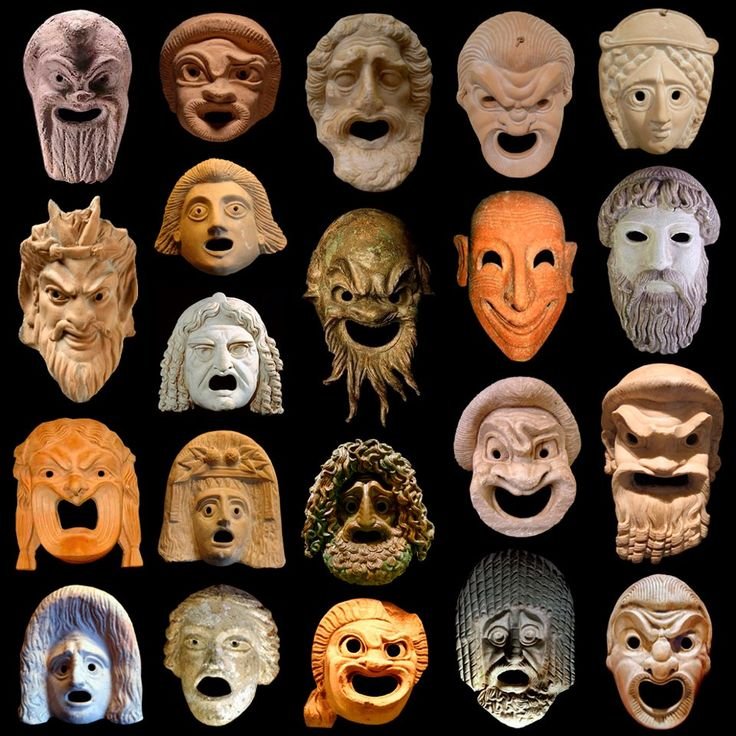
The Greek chorus, by definition, is a group of masked performers that collectively perform many different roles throughout traditional Greek tragedies and comedies. The chorus would be robed head to toe and sing in unison. In summary of their dramatic functions, the Greek chorus provided playwrights with the ability to comment on events within the play, from within the play. The chorus acted as an aside, a way to demonstrate public point of view, an insightful informant, or even used as characters to describe the play's theme. Athenian tragedian Sophocles in his plays Antigone and Oedipus the King used the chorus masterfully. In one scene, the chorus decried Oedipus for his vile action of killing his father and marrying his mother. Collectively, the chorus here provides an insight into the public reputation of Oedipus. Although he was previously considered to be a zealous and just ruler, Oedipus' reputation soon fell apart. The chorus states that the city of Thebes would have been better off without Oedipus and his rule; he became a disgrace to all of his fellow Thebans. However, by the time of Sophocles, the Greek chorus has already reached fruition. His texts do not allude to the chorus's extensive preparation and planning. Beneath the polished hood of a refined play, the choral structure lies. In it, the Greeks found ways to organize and train the layman for the theater stage, and design the chorus to be an effective dramatic tool.
To start, most Greek choruses would sing rather than speak. Playwrights found it easier to evoke emotion from the chorus members rather than rely on their minimal acting skills. These Greek playwrights turned to simple choral odes for the majority of choral lines. Many of the chorus's lines in Oedipus the King have a hint of rhythmic structure.
As for chorus size, each playwright has their own preference. Earliest Greek plays used choruses consisting of fifty members. However, Aeschylus first made the choice to have fewer members—around ten was his verdict. For the purposes of Antigone and Oedipus the King, Sophocles used fifteen members. Greek theaters were very large and as a result, playwrights decided on united, reverberating parts for the chorus so the audience can properly hear.
Playwrights also used the chorus for signaling. The Greeks had no curtains and only outdoor performance venues. Choruses would substitute for curtains, where their opening and closing processions mark the start and end of each act or play.
The coryphaeus is the one chorus member that stands apart from the rest. The coryphaeus would often have individual lines apart from the chorus and be specially trained in order to deliver those lines. The chorus would respond in unison to the coryphaeus' remarks, often in support.
However, the real ringmaster of the Greek Chorus is the choregus or choregos. The choregos is a wealthy Athenian that managed the chorus. He financed and trained the chorus, using his own money. Chorus training in Greek culture was considered a public service; an essential duty that noble Athenians must undertake. There was no government official that ensure that the choregos fulfilled his duty, instead the archon, a high-ranking Athenian magistrate, would appoint the choregos with trust in him. Preparations for the chorus lasted around six months. However, chorus training soon became a social occasion. After successfully providing all of the trainers, preparations, props, costumes, etc. that the chorus needed, the choregos would host a celebratory feast, much like a sports banquet or a modern cast party.
Although the Greek chorus's origins remain mostly unknown, the Greek chorus still proves to be an interesting and extensive dramatic tool. Aside from many Greek performances, some contemporary plays do incorporate a chorus. For example, playwright Mac Wellman's Bad Penny utilizes a chorus in a more modern setting. In addition, the Greek chorus is a common TV trope, albeit only loosely connected to theatre. The chorus in summary is an interesting experiment in drama. It not only serves many unique functions resulting from extensive preparation, but also revealing the dynamism of characters within a play.