Showing posts with label Greek. Show all posts

Wednesday, November 16, 2016

The Importance of Masks in Ancient Greek Theatre- Sarah West

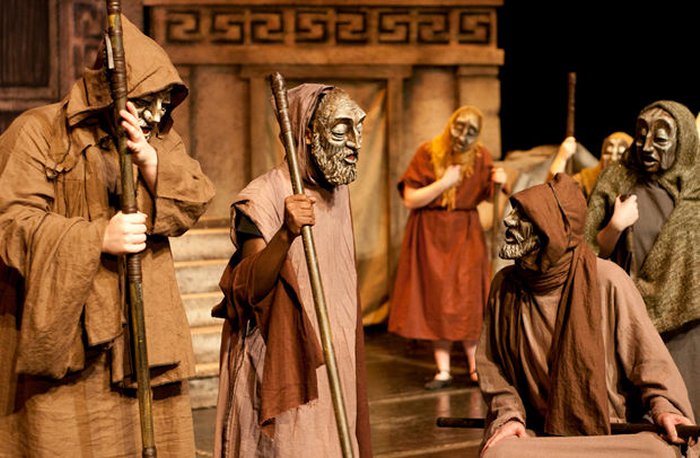
Over the past few weeks, our english class has begun to study greek theatre and read a greek drama, Oedipus the King. During this unit, our class discussed the importance of the theatre to ancient greek society, and the elements involved in a performance. The one element I feel is the most recognizable are the masks that were used to depict emotion.
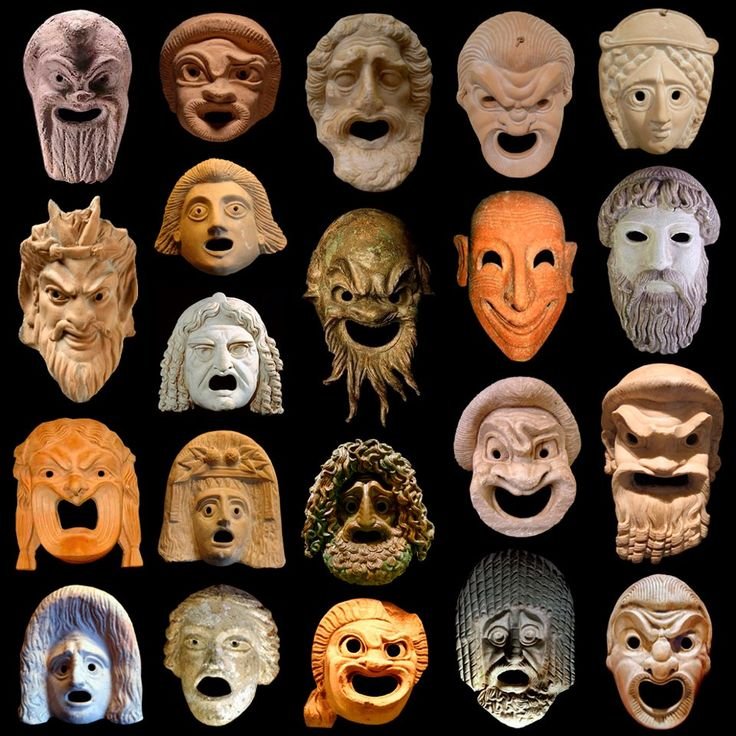
Unfortunately, these masks were often made of organic materials, such as wood or cork, so there is no physical evidence that survives to this day of this ancient greek tradition. However, what we do know about these lost historical artifacts comes from 5th century artwork. The masks were helmet-like, covering the whole head and often included wigs made form human or animal hair. They were used for a variety of reasons, to effectively show emotion and establish a character, to allow the same actor to play multiple characters without confusing the audience, to represent dramatic changes in character throughout a performance, to unify the chorus if it was necessary to show that the whole chorus was meant to portray one multi-voiced character or a specific group of people, and some historians even believe that the opening for the mouth may have even helped to amplify the actors' voices, to more easily be heard throughout the large theater. 


Ancient greek masks were both artistic and beautiful, but also were crucial for the audience's understanding of the drama. Without the largely exaggerated features on the mask it would not be easy for the audience to be able to see the differences in emotion, characters, and characteristics of each character such as gender and social class in the large open air theaters. These masks were a unique and essential element to drama in ancient Greece.


Citation: "Costume & Masks". Greek Theatre. N.p., 2016. Web. 17 Nov. 2016.

Friday, November 4, 2016

The Way In Which Beauty Is Perceived by Owen Welsh

You've heard it all before, "beauty is in the eye of the beholder" or "everyone has different tastes" or "why are you asking me all these questions." Most people just take these to mean that people's ideas of beauty differ from other's preferences, but I propose that this saying stems from the idea of Siren's Song. The Siren's Song is in essence a song in which the Siren convince the listener, usually a sailor, that they're unique and a hero to the Siren and thus convinces the listener to go and try to find them, drowning in the process. Now I like being called a hero as much as the next guy, but I don't think I'd be willing to dive into the ocean for someone I can't even see, so I must imagine that the Sirens were in full view of the sailors. These sailors were all ruffians and scoundrels, but everyone varies in taste about looks so I doubt that one single Siren would be able to woo over many men, unless that Siren's appearance changed in accordance with the viewers tastes.

So if the Siren does change her looks to be more appealing doesn't that mean her beauty is in the eye of the beholder? But what is beauty in it's most raw form? Going off of the Greek idea, Aphrodite would be the most beautiful person in existence, and Paris of Troy confirms that by choosing her as the most beautiful person. But if you take people's personal tastes into account does that mean Aphrodite also shifted looks much like the Siren's, or did she stay in a form that every single person found universally appealing? I would guess that since she is a deity after all, that she appears to be the same to each person, but everyone can agree that her form is beautiful even if they aren't attracted to it.

Now it comes to decision time, is there a universally appealing form or does taste always factor in, I would say that there must be someone that is recognizable as the most beautiful but that does not mean every person is attracted to her/him. Perhaps that's what the Greeks thought about Aphrodite, that she is by far the most beautiful but not the most appealing to someone's particular tastes. But then a conundrum comes up, if a Siren disguises herself to look amazing, does that not mean what Aphrodite may have done by changing her form makes her as low as mere monster? Imagine a god being reduced to using the tactics of a mere monster, just to sway some man over to her side, using the same tricks as a succubus. I doubt that Aphrodite would ever be able to face the other Gods if she did that for every single one of her romantic endeavors, so it's more likely that she retains the same appearance for the most part. While I believe each person has their own opinion on how the perfect person would look, I do believe that their probably is someone out there that I could justifiably say is more beautiful than anyone else in the world.


An Artist's rendition of a Siren.

Thursday, November 3, 2016

How to Understand and Enjoy Greek Literature by Madison Levinson

Greek literature can be very difficult to read and therefore even more difficult to enjoy. Recently, in class, we read The Iliad by Homer. Although we did not read the entire epic, the books we did read of it were frustrating to understand and unpleasant to sit down and read. This left many people procrastinating reading it and put off the reflection questions until the night it was due. Students were scrambling for important quotes and asking others for their interpretations of the text. However, using the rest of this article on how to understand Greek literature, this last minute fright will be a thing of the past...almost as far in the past as the literature you will be reading!

Homer, author of The Iliad 
Since I have personally read The Iliad I will use that epic as an explanation for all of my tips and tricks. But first I will provide a brief explanation of The Iliad for those who have not read it, I wouldn't want anybody to be lost in an article about not getting lost while reading a text!

The Iliad was composed around 800-725 BC, and written by Homer anytime from 725-625 BC. The Iliad is the story of the final weeks of the Trojan war and the Greek siege of the city of Troy. The text follows characters such as Achilles, Agamemnon, Hector, Athena, Aphrodite, Apollo, and Hera. The Trojans and Greeks were fighting because Helen of Troy ran away with Paris, leaving the Trojan King with no wife, locking Troy and Greece into a war of seemingly no end. The poem follows the warriors and their decisions with the influence of the Gods while also teaching valuable lessons to the reader. So how did I figure out all of this information from the impossible epic? Well I am here to show you.

Step 1: Know who's who

An artist rendition of Helen of Troy, the cause of the Trojan War
The first step to understanding any difficult literature is understanding who you will be reading about. In The Iliad there were countless characters to keep track of and various spellings and nicknames for everybody. At the beginning of the book I made a character outline of each person and their relationship to one another as well as if they were Greek or Trojan. For example, Achilles, the Greek, was a warrior who hated the Trojan, Hector, for the murder of Patroklos, the best friend of Achilles. This connects three seemingly random characters to one another and explain their interactions with one another. Keep this character chart with you at all times to refer back to and refresh your memory.

Step 2: Know what you are reading

The second step to understanding difficult literature is to understand what you are actually reading. In The Iliad there are numerous rants and descriptions that can get somewhat lengthy and confusing. Often, I didn't know where the description ended and the actual story began. To prevent this confusion, it is beneficial to read a short summary of the story, like Spark Notes or Cliff Notes. By reading a summary of Spark Notes and then going back and reading the actual literature I had an idea of the chronological order of the story. Any interjections or descriptions were clear as to their end point and I was clear when the actual story picked up again.

Step 3: Do not focus too hard

The third step to understanding difficult literature is not to get caught up on all of the little details. In The Iliad it can be hard not to focus on every little word or every little sentence. It seems like every letter is somehow significant or meaningful. Greek literature is in fact no different than literature we read today. When reading a book do you take notes on every sentence and remember every line of dialogue? So why should you have to for Greek literature? There are often frivolous rants a character will have with themselves, gods, or other mortals. Not all of these sentences are important and necessary to the development of the story. Approach Greek literature as you would any other text and just read, don't worry about a sentence that may seem vague or obscure.

Greek literature does not have to be frustrating and difficult. The story lines are often full of plot twists and dynamic relationships between characters, making it an overall fascinating read. With these tips any reader can find the excitement in Greek culture and classics.
Tuesday, October 18, 2016

Greek God Poseidon: Greek Mythology by Emma Bova

Image result for greek god poseidon  Image result for greek god poseidon
Poseidon is the Greek God of the Sea and protects all aquatic animals. He is the brother of Zeus and Hades. After their father, Cronus, was overthrown, the three brothers split up the universe. Poseidon became lord of the sea, and sailors relied on him for safe passage. He has an imposing and strong figure with long blue hair. He owned two palaces; one at Mount Olympus, and one glorious palace at the bottom of the ocean floor

Poseidon was known to be very moody, and vengeful when insulted; he blinded the son of Odysseus, the cyclops Polyphemus, when Odysseus insulted him. He also loved to cross seas on a golden chariot surrounded by dolphins.

He was the god responsible for in-explainable events at sea, such as saved ships, and drowned lands. His trident was so powerful that it could shatter rocks and cause earthquakes.

Being married to Amphitrite, Poseidon and her produced Triton, who was half human and half fish because Amphitrite was a Nereid (a sea-nymph daughter of Nareus, the old man of the sea). However, Poseidon and Medusa conceived Pegasus, the flying horse, which is one of many mythological creatures. He was also the biological father to Polyphemus, Orion, Pelius along with many others. Despite being married to Amphritrite, he attempted to pursue his own sister Demeter. When she refused him by turning herself into a mare, he transformed himself into a stallion to win her over and together they had Arion, a horse.