Showing posts with label Greek Theater. Show all posts

Wednesday, November 16, 2016

The Importance of Masks in Ancient Greek Theatre- Sarah West

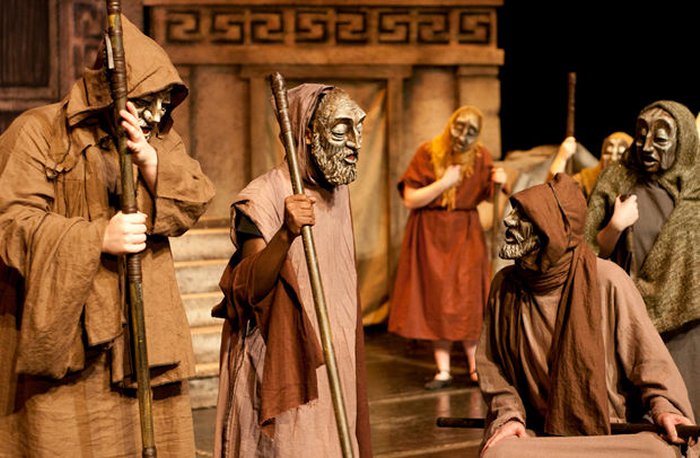
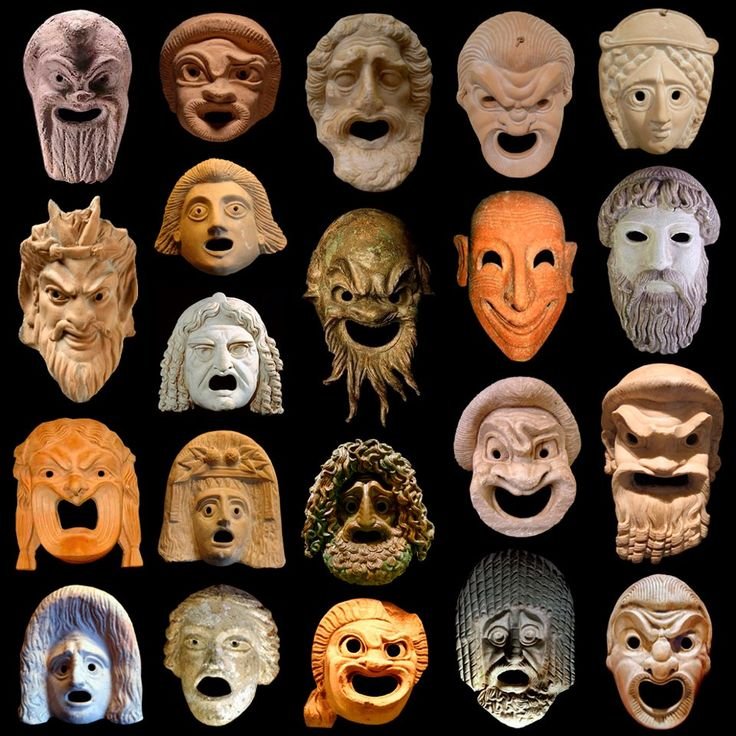
Over the past few weeks, our english class has begun to study greek theatre and read a greek drama, Oedipus the King. During this unit, our class discussed the importance of the theatre to ancient greek society, and the elements involved in a performance. The one element I feel is the most recognizable are the masks that were used to depict emotion.
Unfortunately, these masks were often made of organic materials, such as wood or cork, so there is no physical evidence that survives to this day of this ancient greek tradition. However, what we do know about these lost historical artifacts comes from 5th century artwork. The masks were helmet-like, covering the whole head and often included wigs made form human or animal hair. They were used for a variety of reasons, to effectively show emotion and establish a character, to allow the same actor to play multiple characters without confusing the audience, to represent dramatic changes in character throughout a performance, to unify the chorus if it was necessary to show that the whole chorus was meant to portray one multi-voiced character or a specific group of people, and some historians even believe that the opening for the mouth may have even helped to amplify the actors' voices, to more easily be heard throughout the large theater. 


Ancient greek masks were both artistic and beautiful, but also were crucial for the audience's understanding of the drama. Without the largely exaggerated features on the mask it would not be easy for the audience to be able to see the differences in emotion, characters, and characteristics of each character such as gender and social class in the large open air theaters. These masks were a unique and essential element to drama in ancient Greece.


Citation: "Costume & Masks". Greek Theatre. N.p., 2016. Web. 17 Nov. 2016.

Tuesday, November 15, 2016

How the Greek Amphitheaters Really Amplify Sounds By: Alyssa Stouch


Image result for greek theaterLast week our class learned about the importance of ancient Greek theater. Many aspects of Greek life and society were displayed through the performing arts such as, psychology, sociology, mythology, and more. The theater was a place for men, women, and children of all classes to come together and be entertained. It was found that one theater could hold up to 14,000 people. So how is it that the Greeks were able to amplify their voices for 14,000 people to hear? Some theories claim the masks used during performances worked as megaphones to carry voices. However according to researcher Nico Declercq, the secret lies within the seats. The multiple rows of benches do not appear to be anything peculiar, but it is the simple corrugations on the surface of each seat which carried the sound waves throughout the theater. Plus, the slope of the bleacher-like theater allowed for the sounds to climb more effectively. It amazes me to think of the complex math and sciences the Greeks demonstrated in their everyday lives. The complexity of the theaters should not go unappreciated I enjoyed further researching this topic to discover things as amazing as amplifying volume because it is not something you would imagine as an issue.
Image result for corrugations on greek theater seats