Showing posts with label Greek Mythology. Show all posts

Monday, November 21, 2016

The Oedipus Complex by Chloe Caldi.

The Oedipus Complex

In class we are currently reading Oedipus the King, which is the story of a man who unknowingly kills his father, then marries and procreates with his mother. Oedipus himself is the namesake of the psychological complex that occurs in young boys, usually between the ages of 3-6. These children feel as though they are in competition with their fathers for their mother's attention. They have distaste, anger, or sometimes even aggressive feelings towards their same sex parent. This dislike for father figures is coupled with a sexual desire to be with their mothers. They may even wish for a future with their mothers, wanting to get rid of their fathers, and go on to marry their moms. The same can be said for young girls and their fathers, which is often referred to as the Electra Complex. This is a phase for most children; this taboo desire only lasts through early childhood in most cases. However, some children carry it throughout their lives. This may cause problems in adult relationships, which can be referred to as "mommy issues" or "daddy issues".


Image result for oedipus complex art


Sources:

"Oedipus Complex." Encyclopedia Britannica Online. Encyclopedia Britannica, n.d. Web. 09 Nov. 2016.


Monday, November 7, 2016

Introduction to Greek Architecture by Jillian Parks

Introduction to Greek Architecture

By: Jillian Parks

As the class continues to learn and study Ancient Greece through The Iliad and The Odyssey, it is important that students learn the thorough history of the unique culture, values and structure of the Greeks. One of the aspects Greece is most known for is its famous architecture, which later influenced Roman architecture and architects in profound ways. Greek architecture refers to the architecture of the Greek-speaking peoples who inhabited the Greek mainland and the Peloponnese, the islands of the Aegean Sea, the Greek colonies in Ionia (coastal Asia Minor), and Magna Graecia (Greek colonies in Italy and Sicily). Greek architecture stretches from c. 900 B.C.E. to the first century C.E. (with the earliest extant stone architecture dating to the seventh century B.C.E.) A brief overview of basic buildings demonstrates the range and diversity of Greek architecture. 

Temple:
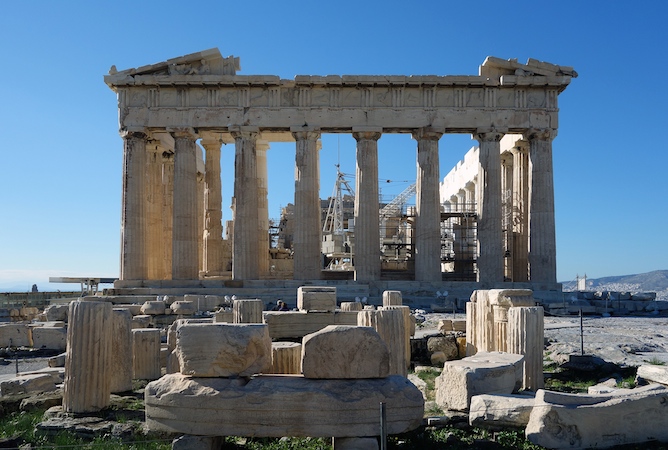
The most recognizably “Greek” structure is the temple. The earliest shrines were built to honor divinities and were made from materials such as a wood and mud brick—materials that typically don't survive very long. The basic form of the temple merges as early as the tenth century B.C.E. as a simple, rectangular room with projecting walls that created a shallow porch. This basic form remained unchanged in its concept for centuries. In the eighth century B.C.E. Greek architecture begins to make the move from ephemeral materials (wood, mud brick, thatch) to permanent materials (stone). During the Archaic period the tenets of the Doric order of architecture in the Greek mainland became firmly established, leading to a wave of monumental temple building during the sixth and fifth centuries B.C.E. Greek city-states invested substantial resources in temple building—as they competed with each other not just in strategic and economic terms, but also in their architecture. For example, Athens devoted a great amount of resources to the construction of the acropolis in the 5th century B.C.E.—in part so that Athenians could be confident that the temples built to honor their gods surpassed anything that their rival states could offer.

 
Iktinos and Kallikrates, The Parthenon, Athens, 447 – 432 B.C.E. , photo: Steven Zucker

Greek temples are often categorized in terms of their ground plan and the way in which the columns are arranged. A pro style temple is a temple that has columns only at the front, while an amphiprostyle temple has columns at the front and the rear. Temples with a peripteral arrangement have a single line of columns arranged all around the exterior of the temple building. Dipteral temples simply have a double row of columns surrounding the building. One of the more unusual plans is the tholos, a temple with a circular ground plan; famous examples are attested at the sanctuary of Apollo in Delphi and the sanctuary of Asclepius at Epidauros.

Stoa:
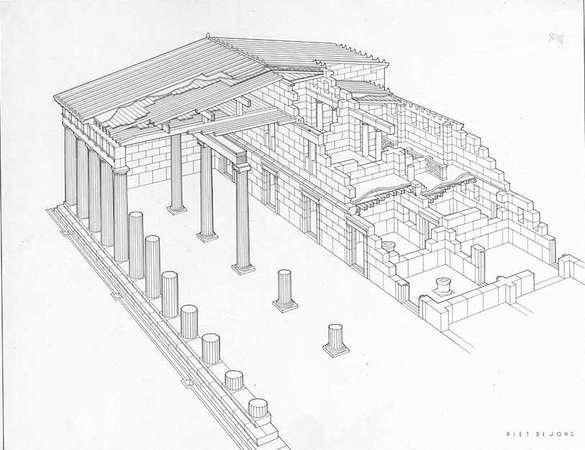
Stoa is a Greek architectural term that describes a covered walkway or colonnade that was usually designed for public use. Early examples, often employing the Doric order, were usually composed of a single level, although later examples (Hellenistic and Roman) came to be two-story freestanding structures. These later examples allowed interior space for shops or other rooms and often incorporated the Ionic order for interior colonnades. 

Greek city planners came to prefer the stoa as a device for framing the agora (public market place) of a city or town. Many cities, particularly Athens and Corinth, came to have elaborate and famous stoas. In Athens the famous Stoa Poikile (“Painted Stoa”), c. fifth century B.C.E., housed paintings of famous Greek military exploits including the battle of Marathon, while the Stoa Basileios (“Royal Stoa”), c. fifth century B.C.E., was the seat of a chief civic official.

P. De Jong, Restored Perspective of the South Stoa, Corint, photo: American School of Classical Studies, Digital Collections

Theater:
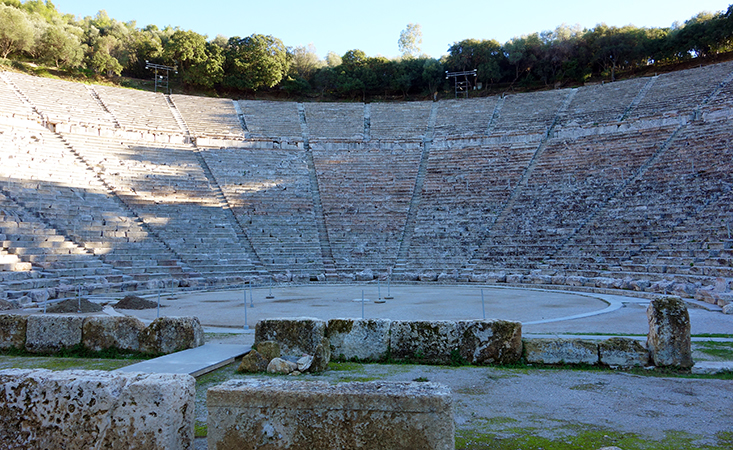
The Greek theater was a large, open-air structure used for dramatic performance. Theaters often took advantage of hillsides and naturally sloping terrain and, in general, utilized the panoramic landscape as the backdrop to the stage itself. The Greek theater is composed of the seating area (theatron), a circular space for the chorus to perform (orchestra), and the stage. The Greek theater inspired the Roman version of the theater directly, although the Romans introduced some modifications to the concept of theater architecture. In many cases the Romans converted pre-existing Greek theaters to conform to their own architectural ideals, as is evident in the Theater of Dionysos on the slopes of the Athenian Acropolis. Since theatrical performances were often linked to sacred festivals, it is not uncommon to find theaters associated directly with sanctuaries.

View of the theatre at the Sanctuary of Asklepios at Epidaurus, c. 350 - 300 B.C.E.

House:
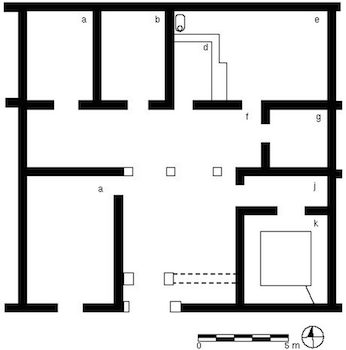
Greek houses of the Archaic and Classical periods were relatively simple in design. Houses usually were centered on a courtyard that would have been the scene for various ritual activities; the courtyard also provided natural light for the often small houses. The ground floor rooms would have included kitchen and storage rooms, perhaps an animal pen and a latrine; the chief room was the andron—site of the male-dominated drinking party. The quarters for women and children could be located on the second level (if present) and were, in any case, segregated from the mens’ area.
Plan, Olynthus (Greece), House A vii 4, built after 432 but before 348 B.C.E., from Olynthus, vol. 8 pl. 99, 100 and fig. 5 (photo: Perseus Digital Library)
Although there came to be many other important structures of the Greeks, these were some of the main ones that later helped to influence the structure of many other famous buildings. 


Thursday, November 3, 2016

How to Understand and Enjoy Greek Literature by Madison Levinson

Greek literature can be very difficult to read and therefore even more difficult to enjoy. Recently, in class, we read The Iliad by Homer. Although we did not read the entire epic, the books we did read of it were frustrating to understand and unpleasant to sit down and read. This left many people procrastinating reading it and put off the reflection questions until the night it was due. Students were scrambling for important quotes and asking others for their interpretations of the text. However, using the rest of this article on how to understand Greek literature, this last minute fright will be a thing of the past...almost as far in the past as the literature you will be reading!

Homer, author of The Iliad 
Since I have personally read The Iliad I will use that epic as an explanation for all of my tips and tricks. But first I will provide a brief explanation of The Iliad for those who have not read it, I wouldn't want anybody to be lost in an article about not getting lost while reading a text!

The Iliad was composed around 800-725 BC, and written by Homer anytime from 725-625 BC. The Iliad is the story of the final weeks of the Trojan war and the Greek siege of the city of Troy. The text follows characters such as Achilles, Agamemnon, Hector, Athena, Aphrodite, Apollo, and Hera. The Trojans and Greeks were fighting because Helen of Troy ran away with Paris, leaving the Trojan King with no wife, locking Troy and Greece into a war of seemingly no end. The poem follows the warriors and their decisions with the influence of the Gods while also teaching valuable lessons to the reader. So how did I figure out all of this information from the impossible epic? Well I am here to show you.

Step 1: Know who's who

An artist rendition of Helen of Troy, the cause of the Trojan War
The first step to understanding any difficult literature is understanding who you will be reading about. In The Iliad there were countless characters to keep track of and various spellings and nicknames for everybody. At the beginning of the book I made a character outline of each person and their relationship to one another as well as if they were Greek or Trojan. For example, Achilles, the Greek, was a warrior who hated the Trojan, Hector, for the murder of Patroklos, the best friend of Achilles. This connects three seemingly random characters to one another and explain their interactions with one another. Keep this character chart with you at all times to refer back to and refresh your memory.

Step 2: Know what you are reading

The second step to understanding difficult literature is to understand what you are actually reading. In The Iliad there are numerous rants and descriptions that can get somewhat lengthy and confusing. Often, I didn't know where the description ended and the actual story began. To prevent this confusion, it is beneficial to read a short summary of the story, like Spark Notes or Cliff Notes. By reading a summary of Spark Notes and then going back and reading the actual literature I had an idea of the chronological order of the story. Any interjections or descriptions were clear as to their end point and I was clear when the actual story picked up again.

Step 3: Do not focus too hard

The third step to understanding difficult literature is not to get caught up on all of the little details. In The Iliad it can be hard not to focus on every little word or every little sentence. It seems like every letter is somehow significant or meaningful. Greek literature is in fact no different than literature we read today. When reading a book do you take notes on every sentence and remember every line of dialogue? So why should you have to for Greek literature? There are often frivolous rants a character will have with themselves, gods, or other mortals. Not all of these sentences are important and necessary to the development of the story. Approach Greek literature as you would any other text and just read, don't worry about a sentence that may seem vague or obscure.

Greek literature does not have to be frustrating and difficult. The story lines are often full of plot twists and dynamic relationships between characters, making it an overall fascinating read. With these tips any reader can find the excitement in Greek culture and classics.

Sunday, October 23, 2016

A Quick Synopsis of Greek Mythology (by Eve Curras)

When I was eleven years old, my older brother and Mom became obsessed with a series new to them, called Percy Jackson & The Olympians.  My brother doesn't often read, so I knew this series would be good.  I quickly became just as obsessed, and Percy Jackson is still one of my favorite book series to date.  The novels are about a young boy who is thrown into a world of gods and goddesses, magical creatures and beasts, and most significantly: demi-gods.  He comes to find that he himself is a demi-god (meaning half-god) and that he is the son of Poseidon, the god of the Sea.  The series entails Percy and his friends attempting to survive and navigate their way through a world like ours, with the exception of a few centaurs, lightning bolts and flying, winged shoes here and there.  This series is what sparked my love for Greek mythology, and I quickly became engrossed in this world that at the time I believed did not differ much from my own.  (Okay, maybe I still believe in gods and goddess, you never know!)
In class we are reading The Iliad, an ancient Greek poem, that much like the Percy Jackson series intertwines Greek mythology with an epic storyline.
To truly understand Greek Mythology, you must understand the main players.  
There are the 3 main gods:
1. Zeus, the King of the Gods & God of the Sky
2. Poseidon, God of the Seas
3. Hades, God of the Underworlds 
Together, they make up The Big Three.
(Zeus/Left, Poseidon/Middle, Hades/Right)
There were a total of 12 gods and goddesses who overthrew the Titans, members of the second generation of divine beings.  They were known as The Olympians.
Including The Big Three, there are 9 other gods and goddesses who contributed to the defeat of the Titans:
-Hestia, Goddess of Family & Domestic Life
-Hera, Goddess of Marriage
-Ares, God of War
-Athena, Goddess of Wisdom
-Apollo, God of Music & Medicine
-Aphrodite, Goddess of Love
-Hermes, Messenger of the Gods
-Artemis, Goddess of the Hunt
-Hephaestus, God of Fire, Blacksmiths & Sculptors
These 12 made up the major deities of the Greek pantheon.  They were led to victory over their predecessor gods, the Titans, by Zeus.  In any novel, story, or epic that is written using Greek mythology, those names will most certainly be mentioned.  I can only hope this helped some students understand the myths and major players of Greek mythology a little bit better.